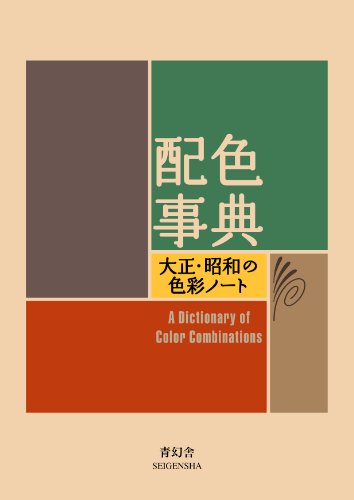
 The book most people find him through is the Seigensha dictionary.
 A painter first
Wada was born in Hyōgo Prefecture and moved to Tokyo at sixteen to become a painter. He studied with Kuroda Seiki, the teacher who brought French plein-air painting to Japan, and graduated from the Tokyo School of Fine Arts in 1904. From 1907 to 1915 he lived in Europe, mostly France, on a government grant, studying both Western painting and craft design. His painting South Wind is in the collection of the National Museum of Modern Art, Tokyo.
That double training shows in the dictionary. Wada learned Western painting in Europe, and his color study set out to record traditional Japanese ways of seeing and pairing color, which differed from Western approaches and used a wide range of subtle shades.
From color research to a national standard
In 1932 he became professor of design at his old school. In 1933 and 1934 he published Haishoku Soukan (配色総鑑), six volumes documenting more than a thousand color combinations. In 1945 he turned the Japan Standard Color Association into the Japan Color Research Institute and led it; in 1951 the institute finished Japan's first comprehensive standard color chart. He was a member of the Japan Art Academy and was named a Person of Cultural Merit in 1958.
The Oscar for Gate of Hell
In 1953 Wada designed the color and costumes for Gate of Hell (地獄門), a Daiei color film. It won the Palme d'Or at Cannes in 1954, where its color was singled out, and Wada won the Academy Award for Best Costume Design at the 27th Academy Awards in March 1955. It is the same eye at work as in the dictionary: whole scenes built from a few deliberately paired colors.
The dictionary, then and now
The book sold today is not the 1930s original. Seigensha's A Dictionary of Color Combinations (2010) is a compact edition based on Haishoku Soukan, with 348 combinations, and a second volume followed in 2020. Measured across the 348 plates on this site:
- 159 distinct colors are reused across all plates.
- 120 plates pair two colors, 120 use three and 108 use four.
The first plates in the book, to start with:
- English Red & Cerulian Blue
- Yellow Orange & Dark Tyrian Blue
- Raw Sienna & Pale Lemon Yellow
- Isabella Color & Red Violet
Browse all 348 combinations, compare Volume 1 and Volume 2, or read what the numbers say about his palette.
Timeline
- 1883
- Born 3 March in Hyōgo Prefecture. The family moves to Fukuoka when he is 13.
- 1899
- Moves to Tokyo at 16 to become a painter and studies under Kuroda Seiki, the leading Western-style painter of the day.
- 1904
- Graduates from the Tokyo School of Fine Arts.
- 1907–1915
- Studies in Europe, mainly France, as a Ministry of Education art student: Western painting and craft design.
- 1932
- Becomes professor of design at the Tokyo School of Fine Arts (until 1944).
- 1933–1934
- Publishes Haishoku Soukan (配色総鑑), a six-volume study of more than a thousand color combinations.
- 1936
- Designs the poster for the 1940 Tokyo Olympics, which were later cancelled.
- 1945
- Reorganizes the Japan Standard Color Association into the Japan Color Research Institute and becomes its chairman.
- 1951
- Completes Japan's first comprehensive standard color chart.
- 1953
- Designs the color and costumes for the Daiei film Gate of Hell.
- 1954
- Gate of Hell wins the Palme d'Or at Cannes, praised for its color.
- 1955
- Wins the Academy Award for Best Costume Design at the 27th Academy Awards.
- 1958
- Named a Person of Cultural Merit.
- 1967
- Dies 22 August in Tokyo, aged 84.
- 2010
- Seigensha publishes A Dictionary of Color Combinations, based on his study.
- 2020
- A Dictionary of Color Combinations, Volume II.
Questions people ask
Who was Sanzo Wada?
Sanzo Wada (和田三造, 1883–1967) was a Japanese painter, costume designer and color researcher. He won the Academy Award for Best Costume Design for the film Gate of Hell (1953) and compiled the six-volume color study that the modern book A Dictionary of Color Combinations is based on.
What did Sanzo Wada win an Oscar for?
For the costumes and color design of Gate of Hell (Jigokumon), a 1953 Daiei film. The award was presented at the 27th Academy Awards in March 1955. The same film won the Palme d'Or at the 1954 Cannes Film Festival.
Is A Dictionary of Color Combinations the original 1933 book?
No. Between 1933 and 1934 Wada published a six-volume study, Haishoku Soukan (配色総鑑), with more than a thousand combinations. Seigensha's A Dictionary of Color Combinations (2010) is based on it and holds 348 of them; a Volume II followed in 2020.
Is there a free PDF of the dictionary?
The Seigensha editions are in print and we do not link to copies of them. What you can use for free is this site: all 348 combinations with hex, RGB and CMYK values, contrast ratios and copy-ready code, one page per plate.
When did Sanzo Wada die?
On 22 August 1967 in Tokyo, aged 84.
— colorcombinations.org editorial
Library
Wada's books and the ones beside them
Both Seigensha volumes, and the color histories designers keep next to them.
Book links are Amazon Associates affiliate links. Your price is unchanged; a small commission supports the archive. As an Amazon Associate we earn from qualifying purchases.
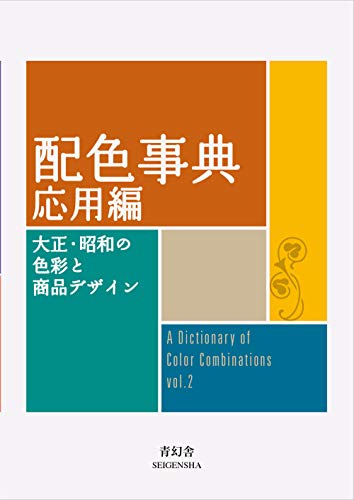


Torn between the two Wada dictionaries? Vol 1 vs Vol 2, compared plate by plate →
Book links are Amazon Associates affiliate links. Your price is unchanged; a small commission supports the archive. As an Amazon Associate we earn from qualifying purchases.