The 1933 Dictionary of Color Combinations is one of the most reproduced color references on the web — its plates are mirrored on dozens of sites and GitHub repositories. What none of those mirrors do is treat the set as a dataset. With all 348 historical combinations and their 159 distinct named colors structured here, a few questions become answerable for the first time. The figures below are computed directly from the archive at build time, so they update whenever the data does.
How many colors are in a Wada combination?
Across the 348 historical plates, the average combination holds 3.0 colors. The most common size is 2 colors (120 of 348 combinations). The full breakdown:
- 2 colors — 120 combinations (34%)
- 3 colors — 120 combinations (34%)
- 4 colors — 108 combinations (31%)
This is the practical takeaway for anyone borrowing from the dictionary: Wada's groupings are small. They are built to be used whole, not sampled from — a 3.0-color set is a complete scheme, not a swatch library to cherry-pick.
The most-used colors in the dictionary
A handful of colors recur far more than the rest. These are the ten that appear in the most combinations across the historical set — the workhorses of Wada's palette:
- Black
#11131423 combinations - Raw Sienna
#bb712519 combinations - Pale Lemon Yellow
#ffefae19 combinations - Sulpher Yellow
#f5ecc218 combinations - Ivory Buff
#ebd3a216 combinations - Turquoise Green
#b5decc16 combinations - Lemon Yellow
#f8ed4315 combinations - Yellow Orange
#f99d1b14 combinations - Eosine Pink
#f37f9414 combinations - Cream Yellow
#fdbf6814 combinations
Each links to its own page, where you can see every combination it appears in and the colors it most often sits beside.
Which hues dominate?
Classified by dominant hue, the most common family is red (163 of 348 combinations, 47%). The full distribution:
- red — 163 combinations (47%)
- yellow — 87 combinations (25%)
- orange — 70 combinations (20%)
- blue — 13 combinations (4%)
- pink — 7 combinations (2%)
- green — 5 combinations (1%)
- neutral — 3 combinations (1%)
Are Wada's palettes legible enough for text?
This is the question modern designers most need answered, and it is the one the dictionary never set out to address — these are pigment combinations chosen for harmony on cloth and paper, decades before screens existed. We measured the strongest WCAG contrast pair inside every combination:
- 39% (135 of 348) contain at least one pair that meets WCAG AA (4.5:1) — usable for body text.
- 19% (67) reach 3:1 only — large headings, not body copy.
- 42% (146) have no pair above 3:1 — fully decorative.
The lesson is not that the palettes are flawed — it is that they were composed for a different medium. If you are using a Wada combination in an interface, do not assume any two members will pass contrast. Pull the lightest and darkest colors of the set for text and background, check the exact pair, and treat the remaining colors as accents and fills. Every per-color page on this site lists its contrast against white and black so you can do this in seconds.
Method
All figures are computed at build time from the 348 historical combinations in this archive (the 30 modern editorial palettes are excluded so the numbers describe Wada's original work). Color frequency counts how many combinations each hex value appears in; hue is each combination's dominant-hue classification; contrast uses the WCAG 2.1 relative-luminance formula on every color pair within a combination. The source palette data is public domain; this analysis is CC BY 4.0.
— colorcombinations.org editorial
Library
Go deeper on colour data and measurement
The books behind this piece — colour theory, history and reference that designers keep close.
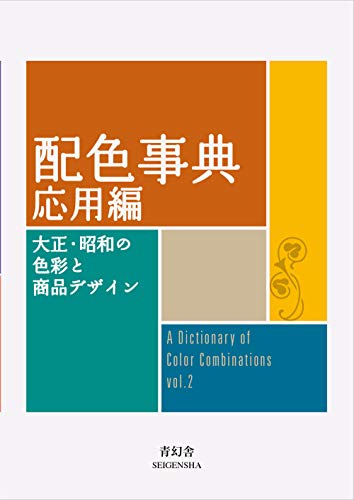


Torn between the two Wada dictionaries? Vol 1 vs Vol 2, compared plate by plate →
Book links are Amazon Associates affiliate links. Your price is unchanged; a small commission supports the archive. As an Amazon Associate we earn from qualifying purchases.
From the archive
Support the archive The full catalog, on your disk, as a thank-you.
- All 378 palettes (348 Wada + 30 editorial) in five formats
- Figma design tokens (W3C-spec JSON, drag into any file)
- Tailwind v4 + v3 configs — drop into any project
- CSS custom properties — every plate, one stylesheet
- 378 museum SVG plates — print-ready at any size
- Full JSON — colors, names, eras, moods, dominant hues
Launching soon. The free archive stays free, always.